
Seven inches is the wrist the watch industry designs around, which sounds like good news and is mostly a trap. When nothing is ruled out by fit, nothing narrows the choice, and people buy by diameter because it is the only number in front of them.
The useful question at this size is not what fits but what suits. The size and fit guide covers the measurements; this covers deciding without a constraint to lean on.
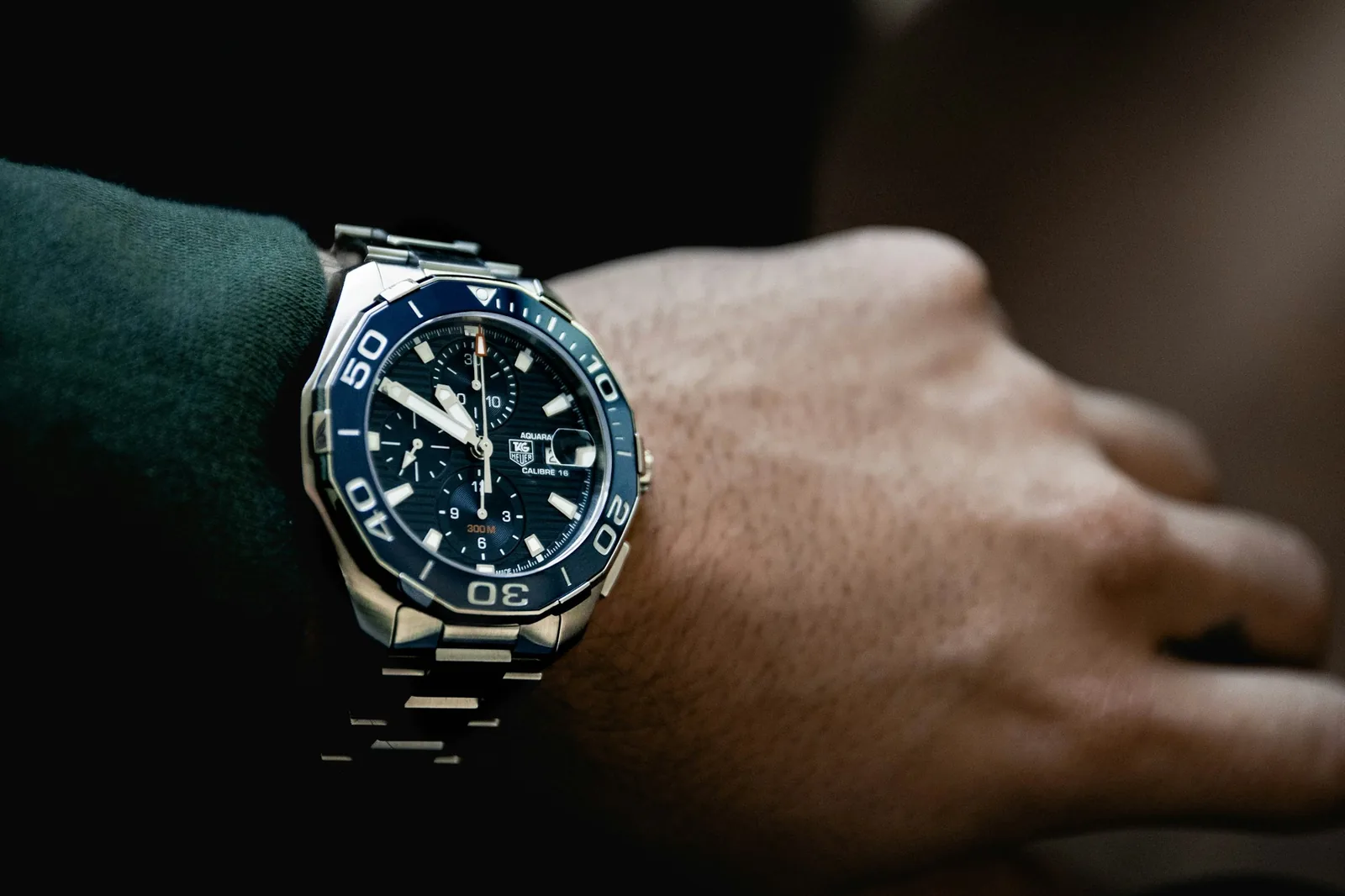
The numbers for a 7 inch wrist
Seven inches around gives roughly 52mm across the flat. That accommodates lug-to-lug up to about 50mm comfortably and 54mm at the ceiling.
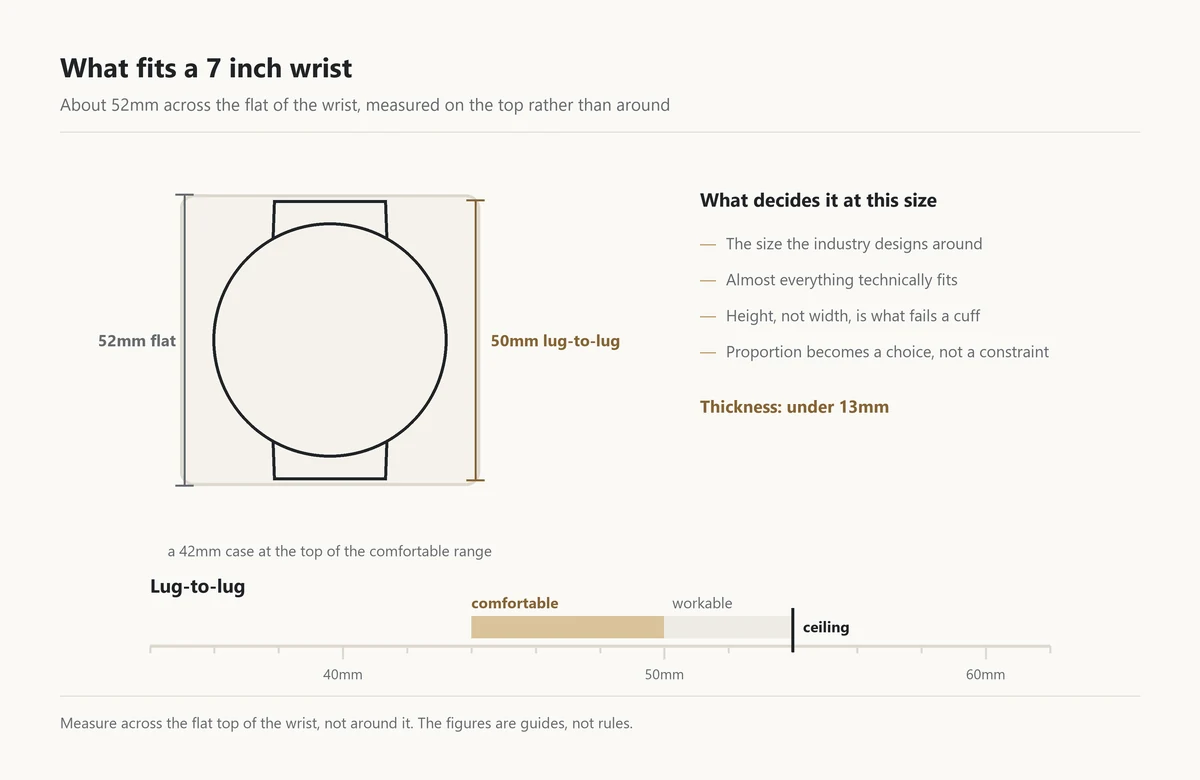
Since the great majority of watches sold sit between 44 and 50mm of reach, the practical answer is that the fit test passes almost every time.
Watch fit for a 7 inch wrist explained for beginners
| Measurement | Comfortable | Workable | Too much |
|---|---|---|---|
| Lug-to-lug | 44–50mm | up to 54mm | over 54mm |
| Diameter | 38–43mm | up to 45mm | over 45mm |
| Thickness | under 13mm | up to 14mm | over 15mm |
| Lug width | 20–22mm | 24mm | 26mm |
Every column here is wider than on the 6.5 inch guide, and that is exactly the difficulty: the table stops eliminating anything.
What still fails at this size
Two things, and neither is width.
Height fails first. A 15mm case is 15mm whatever your wrist measures, and it catches on a cuff identically on a 6 inch wrist and a 7 inch one. Thickness is the only measurement that does not scale with you.
Weight fails second. A heavy watch on a soft strap slides round the wrist regardless of size, and a full steel bracelet on a large case is a genuine all-day presence.
So the two tests worth applying are the cuff test and the let-go test: put it on, drop your arm, and see whether the watch stays where you put it.

How to measure watch fit for a 7 inch wrist
- Measure across the flat — expect around 52mm.
- Confirm lug-to-lug is under 54mm, which almost everything is.
- Move straight to thickness and treat 13mm as the working limit.
- Check the weight if it comes on a bracelet.
- Decide the proportion you want rather than the one you can carry.
- Try both a smaller and a larger case before deciding.
Step six is the one that matters here. With fit no longer deciding, the only way to choose is comparison, and most people who try 38mm and 42mm side by side are surprised by which they prefer.
Why “average” is a distribution, not a size
Seven inches gets described as the average male wrist, which is roughly right and more slippery than it sounds.
Population statistics are distributions rather than single figures, and national statistical bodies such as the Office for National Statistics publish body measurements that way for exactly that reason: the mean tells you very little about the spread around it.
Applied to watches, that means a case sized for the average fits a great many people badly at both ends. It is why the industry’s default has swung from 34mm to 44mm and back within living memory.
The practical upshot is to distrust “standard” as a description of a case size, and to measure instead.
Common watch fit for a 7 inch wrist mistakes
Buying large because you can is the first. Fit is a floor, not a recommendation, and the oversized fit guide covers what large actually asks of you.
Ignoring height because width passed is the second, and it is the specific failure at this size.
Dismissing smaller cases is the third. A 38mm watch on a 7 inch wrist reads as classical rather than small, which the small watch fit guide explains.
And buying without trying two sizes is the fourth, because with no constraint to guide you, comparison is the only remaining instrument.
The advantage worth using
The real benefit of this wrist size is not that big watches fit. It is that the whole range does.
A thin dress watch, a 40mm everyday watch and a 42mm diver will all sit properly, which means a small collection can genuinely cover different jobs rather than repeating one — the starter collection guide covers that approach.
It also means strap and bracelet sizing is a non-issue. Standard lengths fit, bracelets size with links to spare, and 20 and 22mm lugs are the best-served widths on the market.
Freedom from constraint is worth something. It is just worth using deliberately rather than spending on diameter.
What the archive shows about the standard size
The 2006 and 2007 retail catalogue preserved on this site never printed a case diameter, which is itself the point.
A shop selling across a counter did not need to: the customer put the watch on. Size became a headline specification only when watches started being bought unseen.
What the catalogue does record — brand, model, retail price and catalogue price across 294 priced entries — is what a buyer was thought to need. You can browse it in the watch finder.
How to choose when nothing is ruled out
With the fit test passing on everything, three questions do the narrowing instead.
What does the watch have to do? A watch that must go under a cuff has a height limit; one that never does has none. That single question eliminates more than any measurement.
What are you already wearing? If everything you own is 40mm, the useful purchase is deliberately not 40mm, or you have bought the same watch again.

And how heavy are you willing for it to be? Weight is the dimension nobody quotes and everybody notices, and a steel bracelet on a 42mm case is a real all-day presence.
Answer those three and the choice narrows to a handful, which is what the fit measurements would have done on a smaller wrist.
It is worth adding a fourth question for anyone buying their second or third watch: what does this one do that the others cannot? At a wrist size where everything fits, that is the only discipline left.
Without it, a collection at this size tends to become several versions of the same 40mm watch in different colours, which is an expensive way to own one watch.
Frequently asked questions
What size watch fits a 7 inch wrist?
Almost anything between 36 and 44mm, with lug-to-lug under about 50mm. Because so little is ruled out, the more useful question at this size is which proportion you actually prefer.
Is 7 inches an average wrist?
Roughly, for adult men. But an average is a point in a distribution, not a size, and a watch designed for it fits a great many people badly at both ends of that spread.
Can a 7 inch wrist wear a 36mm watch?
Yes, and it reads as classical rather than undersized. The proportion is roughly what watches were for most of the twentieth century. Keep the lug width at 18 or 20mm to match.
What still does not fit at 7 inches?
Height and weight. A 15mm case catches a cuff regardless of wrist size, and a heavy watch on a soft strap slides round the wrist however well it fits across the top.
At 7 inches the fit test stops filtering, so apply the two that still do: check the height, and try two sizes before deciding.